Why Every Small Business Needs a Website
November 23, 2026 · 7 min read
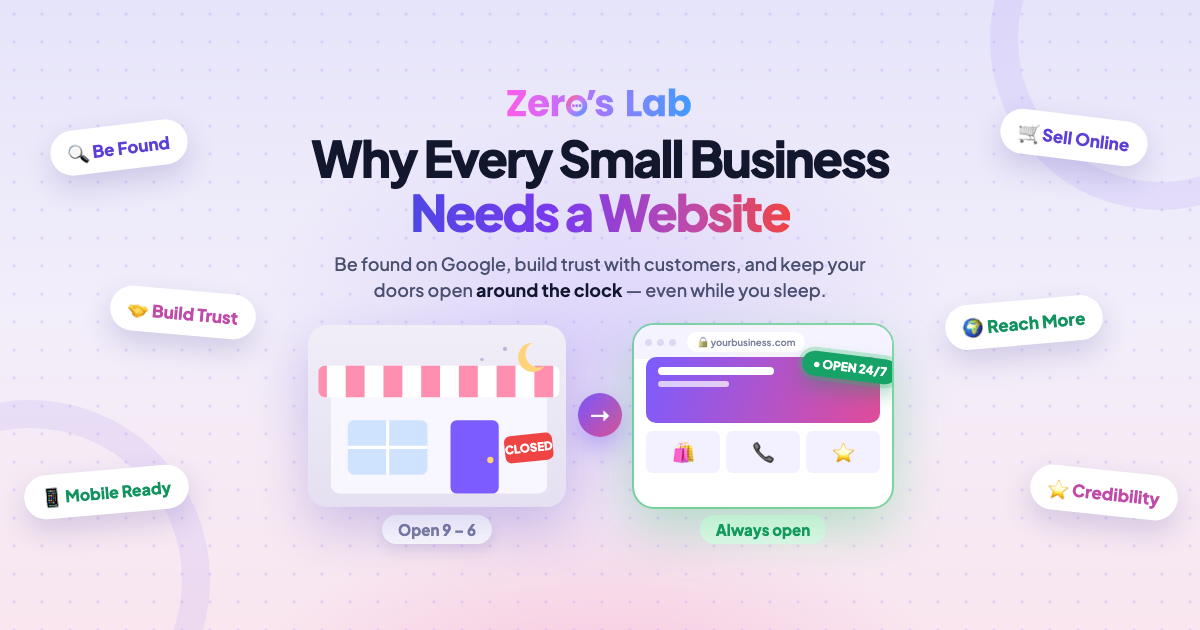
If you run a small business, you already have a website. It might be your Facebook page, your Google Business Profile, or a listing on a marketplace. The problem is that you don't own any of them. You rent them — the rules, the reach and the audience all belong to someone else.
A website you own is different. It's the one place online where you control the message, the pricing, the customer data and the experience, and where nobody can change the rules on you overnight. Here's an honest look at what a website actually does for a small business, what it costs you to go without one, and how to get one built without overcomplicating it.
Your customers look you up before they call
Most buying decisions now start with a search, or with a link from someone the customer trusts. Before they call, email or walk in, they have usually already checked whether you look real. A website is how you answer that question on your own terms — with your work, your services, your location, your team and your story.
Without one, that check happens somewhere you can't control: an old directory listing, a review page with a few stale complaints, or nothing at all. Silence online reads as "closed" or "risky," even when the business itself is thriving.
A website is the only channel you own
Social platforms are good for reach. They're bad as your only home base. Reach changes without warning, accounts get locked, and you can't export your followers. Your website is the asset that compounds: every service page, article and search ranking keeps working for you long after you publish it.
Social media is where people discover you. Your website is where you send them once they're interested. The two work best together — but only one of them is yours.
What a good small business website actually does
1. Builds trust in the first few seconds
Visitors decide quickly. A clear headline, real photos, obvious services, visible contact details, and a site that loads fast on a phone. If any of those are missing, they move on to a competitor who got them right.
2. Turns searches into leads
When someone searches for a service you offer, you want to be the result they click. That means a fast, mobile-friendly site with pages that match what people actually type — one page per service, not one page for everything.
3. Answers questions before they're asked
Hours, pricing ranges, service areas, turnaround times, what to bring, how the process works. Every question your site answers is a phone call you don't have to take, and a customer who arrives already half-sold.
4. Works when you're closed
A website takes orders, bookings and enquiries at 11pm on a Sunday, on a public holiday, while you're on leave. It doesn't get tired and it doesn't forget to follow up.
5. Gives paid traffic somewhere to land
Ads without a landing page waste money. If you ever run a campaign, a website is where you send the clicks — and where you can measure what actually converted.
What it costs you to go without one
- Leads you never see. People who searched, found nothing convincing, and went elsewhere. You don't get a report on these.
- Price pressure. Without a site that explains your value, you end up competing on price alone.
- Dependence on platforms. One policy change or locked account can cut off your pipeline.
- Repeated manual work. Answering the same questions by phone and DM, every single day.
- No data. No idea which services people want, which pages they read, or where they drop off.
"But I get all my business from word of mouth"
Word of mouth is the best marketing there is. It also almost always ends in a search. Someone recommends you, the person pulls out their phone, and what they find either confirms the recommendation or quietly kills it. A website doesn't replace word of mouth — it's where word of mouth gets verified.
Three other objections come up often enough to address directly:
"I'm too small to need one"
Small is exactly when a website helps most, because you don't have a sales team to chase every lead. A good site does the first round of selling for you.
"My Facebook page is enough"
Until it isn't. Platforms change their algorithms, their features and their terms. You can post on Facebook — just don't let it be the only place your business exists.
"It's too expensive"
A focused five-page site is a one-time cost that works for years. Compare it to what you already spend on ads, printing, or a single month of rent. If you want to keep costs down, start small and expand later — a theme or template can get you a professional presence without a custom design budget. Browse the Zero's Lab shop for themes and UI kits, or read on for how to decide.
What "good" actually looks like
You don't need a 40-page website. You need a small one that's done properly. The bar is roughly this:
- Fast. Loads in a couple of seconds on a mid-range phone over mobile data.
- Mobile-first. Most of your visitors are on a phone. Design for that screen, not the desktop.
- Clear in five seconds. What you do, who you do it for, and what to do next.
- One obvious action per page. Call, book, buy or enquire — pick one.
- Real content. Your photos, your services, your prices or ranges, your location.
- Secure and maintained. HTTPS, updates applied, backups running.
- Findable. Correct titles, descriptions and structure so search engines understand your pages.
- Yours. Domain, hosting and code in your name — not locked inside someone else's account.
Build it yourself, buy a template, or hire a team
All three are valid. The right answer depends on what the site has to do for your business.
| Approach | Best for | Watch out for |
|---|---|---|
| Do it yourself with a site builder | A one-page presence on a very small budget, launched this week | Your time, plugin upkeep, and a ceiling you'll hit as you grow |
| Buy a theme or template | Businesses that want a polished look without a custom design budget | You still handle hosting, setup and ongoing maintenance |
| Hire a design and development team | Sites that must generate leads, take bookings, or connect to other systems | Higher upfront cost — so agree scope, timeline and ownership in writing |
If you go the custom route, insist on one thing above all: you keep the code and the IP. At Zero's Lab, that's the default — clients own everything we build, and the site runs on infrastructure you control. You can see how we scope website work on our services page.
A simple launch checklist
- Pick one goal. More calls, more bookings, or more online sales. Not all three.
- Write one page per service. Use the words customers use, not internal jargon.
- Put the essentials on every page. Phone number, location, hours, and a clear call to action.
- Use real photos. Your shop, your team, your work. Stock images are better than nothing, but barely.
- Test on an actual phone. On mobile data, not office Wi-Fi.
- Connect the form to a real inbox. Then send yourself a test enquiry and confirm it arrives.
- Add analytics. You can't improve what you don't measure.
- Claim and update your Google Business Profile. Link it to the site.
- Check the basics. HTTPS working, no broken links, correct phone number, correct address.
What to measure after launch
- Enquiries and calls. The only metric that matters most weeks.
- Which pages people land on. That tells you what customers actually want.
- Search queries. The phrases that bring people in — turn them into page titles.
- Mobile vs desktop split. It confirms where to spend your design effort.
- Load time. Check it monthly; sites slow down as they grow.
The bottom line
A small business website isn't a marketing expense you tick off once. It's the part of your business that keeps selling, answering and qualifying while you do the actual work. Start with a handful of good pages, make them fast and clear, and own every piece of it.
If you'd rather have it done properly the first time, we build websites and web apps for businesses of every size — with a fixed scope, clear timeline and full ownership for you. Tell us what you need and we'll tell you honestly whether you need a custom build or something simpler.