E-commerce vs F-commerce: What Your Business Really Needs
November 23, 2026 · 8 min read
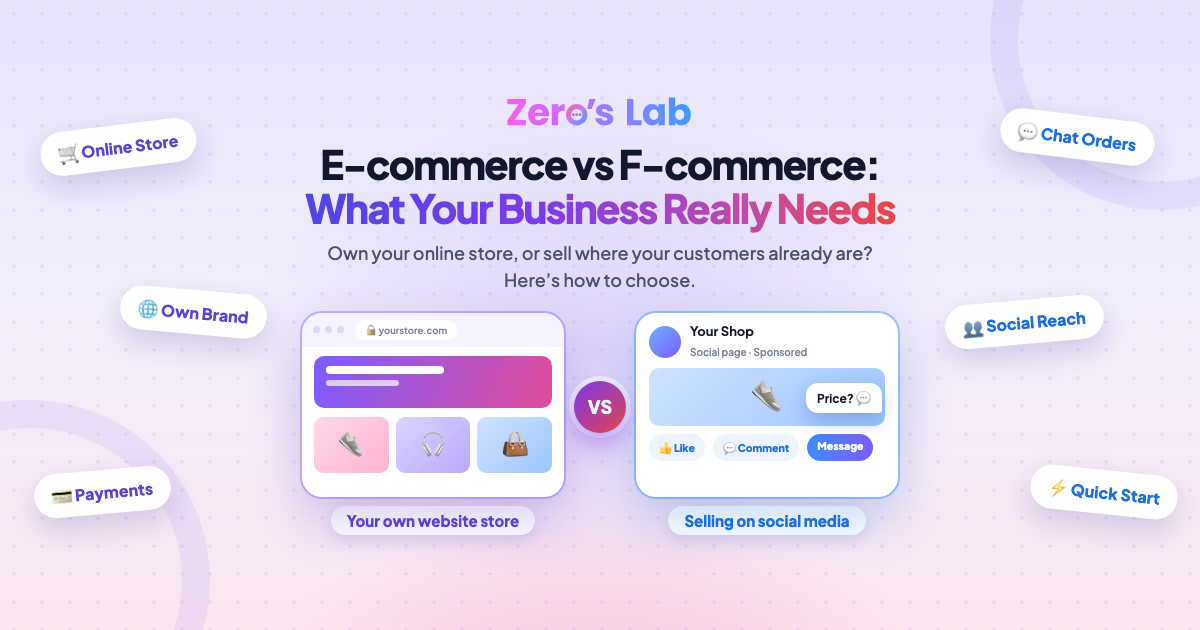
If you run a small or mid-sized business, you have probably sold something through a Facebook page: a comment thread, a Messenger inbox full of order details, a screenshot of a payment confirmation. It works. It is also not a system.
"F-commerce" (Facebook commerce, and by extension Instagram, Messenger and WhatsApp selling) and "e-commerce" (a store on your own domain) get framed as rivals. They are not. They solve different problems, and the right answer depends on your order volume, your margins, how you fulfil, and where your customers already spend their attention.
The two models, defined plainly
F-commerce
You sell through a social platform. The catalogue lives in a page shop, a pinned post or a photo album. Orders arrive as comments, direct messages or phone calls. Payment is collected by mobile wallet, bank transfer or cash on delivery, and delivery is arranged manually or through a courier you coordinate over chat.
E-commerce
You sell through a website you control. Products have structured data: price, variants, stock. The cart and checkout are automated. Payments go through a gateway, and every order lands in a system you can query, export and reconcile.
The distinction that actually matters is not "social versus website". It is conversation-driven selling versus transaction-driven selling. One scales with your team's attention. The other scales with your systems.
Side-by-side comparison
| Factor | F-commerce | E-commerce |
|---|---|---|
| Where customers are | Inside a platform they already open every day | On your domain, reached via search, ads, social links or email |
| Setup effort | Hours: a page, photos, prices in captions | Days to weeks: storefront, catalogue, checkout, payments, delivery |
| Ongoing cost | Mostly your team's time, plus ad spend | Hosting, gateway fees, maintenance, plus ad spend |
| Order handling | Manual: comments, DMs, phone calls | Automated: cart, checkout, order records, status updates |
| Data you own | Very little; the audience belongs to the platform | Catalogue, customer list, order history, analytics |
| Payments | Wallet, transfer or cash on delivery, reconciled by hand | Gateway checkout with automatic status updates |
| Google visibility | Almost none | Product pages can rank and be linked |
| Scale ceiling | How many conversations your team can hold per day | Fulfilment capacity and inventory |
| Main risk | Policy changes, account restrictions, throttled reach | Uptime, security and technical debt are your problem |
Where F-commerce genuinely wins
- Zero infrastructure to start. No domain, no hosting, no developer. You can take your first order today.
- Discovery where people already are. You do not have to teach anyone to find you; the feed does the introducing.
- A lower trust barrier. Buyers wary of paying online upfront can choose cash on delivery, and a familiar profile feels safer than an unknown website.
- Fast demand signals. Post a photo, watch the comments, and you know within hours whether a product is worth stocking.
- Good for small or made-to-order catalogues. A handful of SKUs and a personal touch suit a conversation-based sale.
- Cheap to test a new market or a new product line before you commit engineering time to it.
Where F-commerce quietly breaks
None of this is a knock on the model. These are the failure points that show up once a business outgrows it.
- Every order is a conversation. Revenue is capped by how many DMs your team can answer per hour, and by how quickly they answer them.
- No real inventory. Without structured stock, you oversell, apologise, then lose both the customer and the review.
- Reconciliation pain. Matching a DM to a wallet payment to a courier slip to a delivered parcel is manual work that grows in a straight line with order count.
- You are renting your audience. Reach can be throttled, accounts can be restricted, and a policy change can remove a channel overnight.
- No search traffic. Nothing posted on a social platform ranks on Google, so you cannot be found by someone actively searching for what you sell.
- No funnel. No abandoned-cart recovery, no structured upsell, no email or SMS list you can market to again.
- Weak attribution. Which post actually produced the sale? Usually nobody can say with confidence.
- Handover chaos. When the person who runs the inbox is away, the business stops selling.
The clearest signal that you have outgrown F-commerce is not your follower count. It is the number of orders your team failed to answer in time.
Where e-commerce wins
- You own the asset. Domain, catalogue, customer list and order history are yours. If you change platform or agency later, they come with you.
- Every channel has somewhere to land. Ads, search results, creator posts and printed packaging can all point to a page you control.
- Automation replaces admin. Stock updates, invoices, courier booking, delivery notifications and refunds can run without a human in the loop.
- It compounds. Product pages, reviews and content keep bringing in traffic long after the ad budget stops.
- It is measurable. Traffic source, conversion rate, average order value and repeat rate become numbers you can act on.
- It supports more payment options, including card and wallet gateways that reduce cash handling and fraud exposure.
Where e-commerce is the wrong first move
Honesty matters here, because we build websites for a living and still tell people to wait sometimes.
- You have no proven demand yet. If you cannot sell ten units through DMs, a storefront will not fix the product.
- You cannot service the traffic. A website sends you orders faster than a chat inbox. If fulfilment, packaging or stock is already the bottleneck, software makes it worse.
- You are not ready to answer questions. Some products need consultation before purchase. In that case, keep the conversation and use the site as a catalogue, not a checkout.
- You have no one to own it. A store is a living thing: prices, stock, offers, bugs. If nobody owns it internally, it decays.
The hybrid setup most businesses actually need
In practice the answer is rarely "pick one". It is usually: social for demand, a website for transactions.
- One source of truth for the catalogue. Products, prices and stock should live in one place and be published to both the site and the social pages. Update twice by hand and the two will disagree within a month.
- Social as the top of the funnel. Content, comments and ads create interest. Every post points to a product page with a clear price and a checkout button.
- The website as the transaction layer. Cart, checkout, order records, invoices and delivery status. This is where the manual work disappears.
- Messaging as support, not as the order system. Keep WhatsApp or Messenger open for questions, but push the order itself into the store so it is recorded.
- Payments matched to the buyer. Local customers expect the payment methods they already use; international customers expect a card checkout in their own currency. Support both rather than forcing one.
- Own the customer list. Email, SMS or a loyalty list is the only audience you can reach without asking a platform for permission.
A short decision checklist
Answer these before you spend money on either option.
- How many orders per day do you handle now, and how many of them involve a back-and-forth conversation?
- How many hours per day does your team spend answering order messages instead of selling or shipping?
- Do you lose sales when messages go unanswered overnight or on holidays?
- Do you know your repeat purchase rate? If not, can you calculate it from your current records?
- Do customers search for your product on Google, or only find you through the feed?
- Can your fulfilment keep up with two or three times the current order volume?
- Do you sell cross-border? If yes, you need multi-currency checkout and international card payments.
- Who will own the website after launch: an internal person, or an external team on a support agreement?
If your answers point to "we are losing orders we already earned", the problem is operational and a website solves it. If they point to "we are not sure anyone wants this yet", stay on social a while longer and prove demand first.
What this looks like in engineering terms
For the technically minded, the hybrid setup is not exotic. A typical stack for a mid-sized catalogue looks like this:
- A headless or conventional storefront (Next.js or a hosted platform) rendering product pages that are fast and indexable.
- A product and inventory service backed by PostgreSQL as the single source of truth.
- Payment gateway integration for local and international rails, with webhook-driven order state so nothing depends on a customer's browser finishing a redirect.
- A courier or fulfilment integration that turns a paid order into a pickup request automatically.
- Redis for carts, sessions and rate limiting; a job queue for emails, invoices and stock syncs.
- Analytics wired to order data so you can attribute revenue to a channel instead of guessing.
The point of all this plumbing is simple: an order should be captured, paid, recorded and shipped without a human retyping anything. That is the actual difference between F-commerce and e-commerce. One runs on your team's memory. The other runs on software.
Where we fit in
We build storefronts, internal order systems and the integrations between them, and we are happy to tell you when you do not need one yet. If you are weighing up a first website or replacing a spreadsheet-and-inbox workflow, our website design and development and custom software engineering teams handle both ends. If you would rather start smaller, our shop has fixed-price website themes and engineering packages you can buy and book directly.
Either way, the decision comes down to one question: do you want your growth limited by how many messages your team can answer, or by how much you can ship?